Most of the content that should exist doesn't.
Not because the people who could write it lack ideas. Not because they don't know their subject. They do. But knowing something well and being able to sit down and turn it into publishable content, consistently, without it eating half your week — those are different skills, and most people only have one of them.
That gap is where Riterly lives.
The gap nobody talks about
Writer's block is a romantic problem. The reality is less dramatic: you have twenty minutes between meetings, a topic you know cold, and a cursor that's been blinking at you for three of those minutes while you try to figure out how to start.
So you don't. The draft doesn't happen. The idea lives in your head or a notes app and eventually dissolves.
This isn't a discipline problem. It's a bandwidth problem. The distance between "I could write something useful about this" and "I have a draft worth finishing" is real, and for most people who write alongside their actual work, that distance is just slightly too far to cross every time.
That's the problem Riterly was built to solve. Not "write content for me", but to close the gap between the content you could produce and the content you actually do.
What I built before I built Riterly
I'm Ron Ferguson — a developer, husband, dad, and grandfather. Not a writer. And for a long time, I lost the battle with the blank cursor like everyone else.
I didn't start by building a product. I built a tool for myself: a PHP/Symfony CLI agent that would draft blog posts for somewhere between four and eight cents each. Not because it was cheap, but because I wanted to understand whether the gap could actually be closed, mechanically, without losing what made my writing mine.
The first outputs weren't good enough. That was expected. What wasn't expected was what happened over ten to twenty profile editing cycles across five days: the drafts started to sound like me. Not approximately. Not close enough. Like me — only better than I could write myself.
That's the version that became Riterly.
When Dries Buytaert stood up at DrupalCon Chicago in 2026 and described the same architecture as the centerpiece of Drupal's AI strategy, he hadn't seen my tool. The convergence was independent. We both arrived at the same answer from different directions: a structured writing profile, a human in the loop, and AI that generates drafts shaped by a specific person rather than defaulting to a generic register.
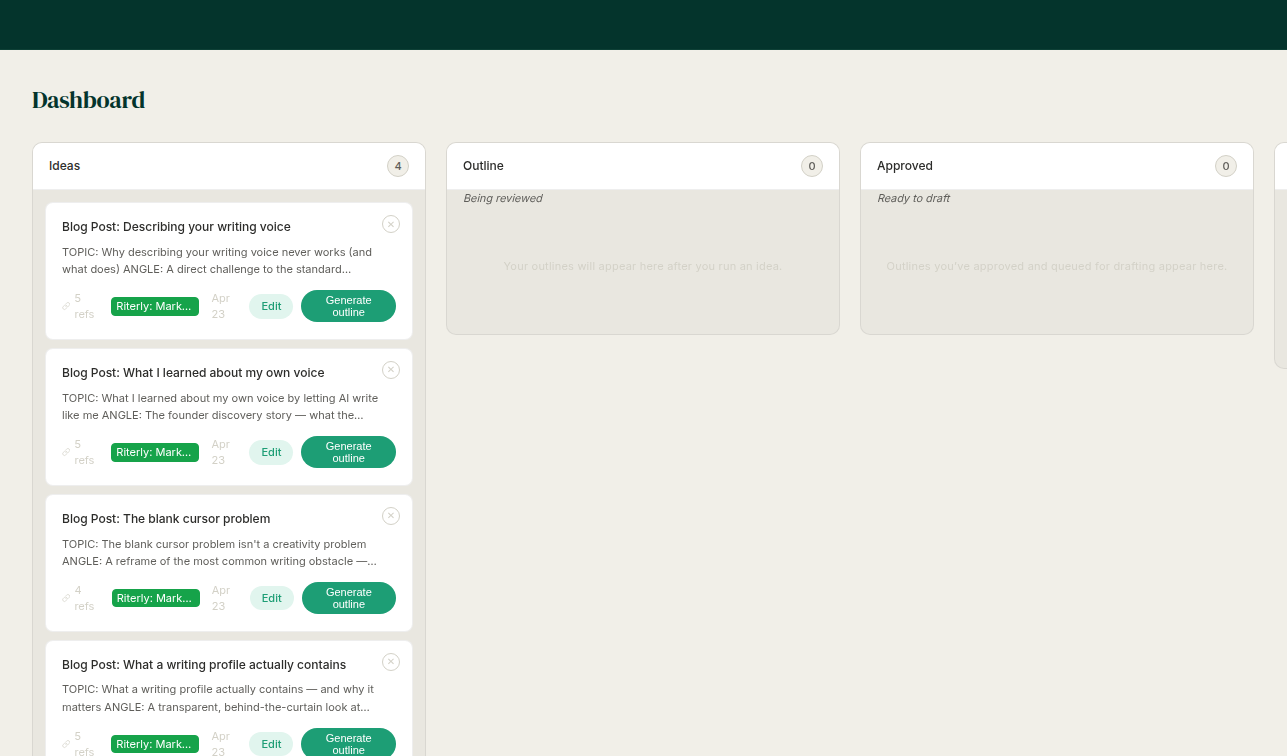
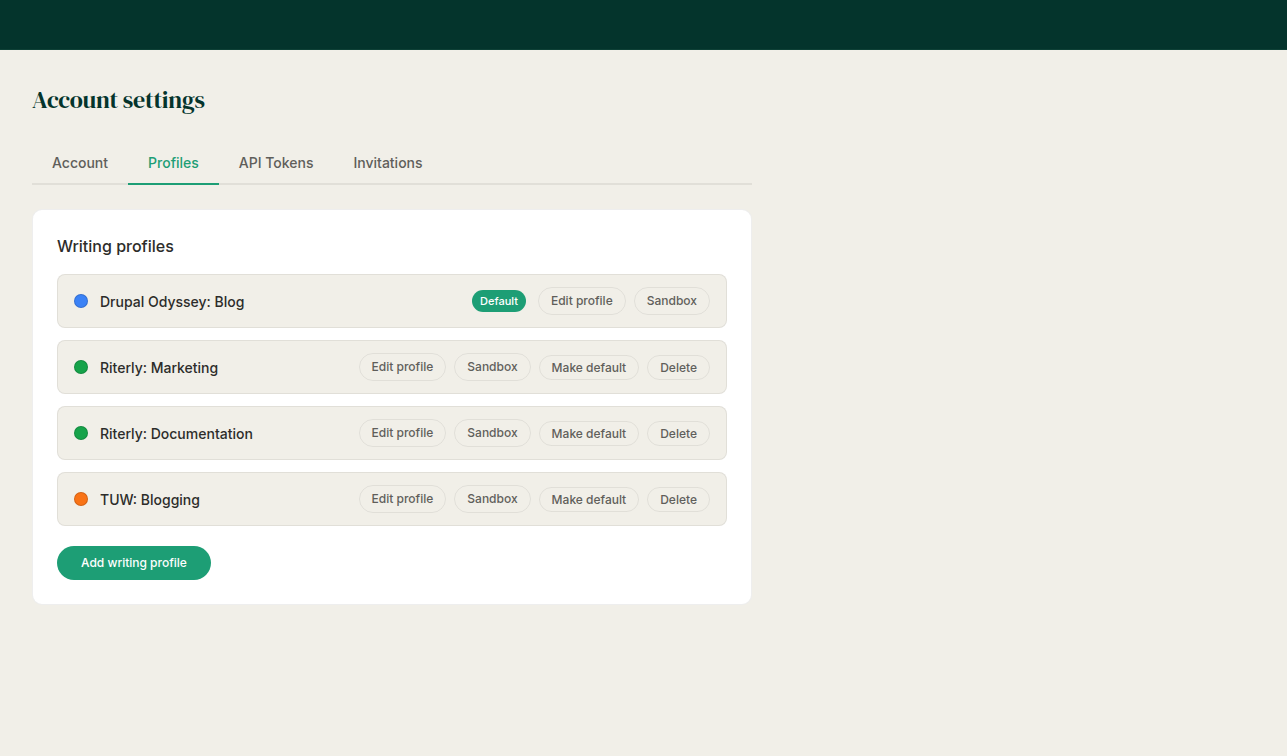
Here's what Riterly actually does
The mechanism is called the writing profile. Not a style guide. Not a persona. Not a voice model.
A writing profile is a structured representation of how you actually write — your patterns, your preferences, your topics, your audience, the things you reach for when you're at your best. It's built through a six-step wizard: who you are, who you're writing for, your voice and tone, your language patterns, how you structure content, what you cover. You don't start from zero — when you sign up, you select a niche and a profile template loads as a starting point.
That's Layer 1: what you think your voice is. Every competitor stops there.
Riterly keeps going. The Voice Workshop exists specifically to close the gap between what the wizard captured and what actually sounds like you. You read the draft, you shape it, you mark what's right and what's off. Each cycle brings the profile closer. The output you get on day five isn't the output you'd get on day one — because the profile is more accurate.
That gap between what gets generated and what you actually publish — that's where the real work happens. And it's where Riterly works.
When you request a draft, you're not prompting a general-purpose AI and hoping something coherent comes back. You're getting a draft that was shaped by everything in your profile: your voice, your audience, your structure, your topics. Something you can read back and recognize.
It won't be finished. It's not supposed to be. It's a draft — something you shape until it sounds right. That's not effort. That's control. You're the editor, not the author's assistant.
Why this launch is slow on purpose
Riterly isn't launching to everyone ... yet.
The private beta is invite-only, and that's deliberate. A writing profile that actually sounds like you takes refinement. The product is built for people who care about voice — not people chasing volume. Those are different audiences, and Riterly is only useful to one of them.
If you don't care whether your content sounds like you, Riterly won't serve you well. It's not a content mill. It's not a ghostwriter. It doesn't do the thinking. What it does is give you a draft that's already close — so your editing goes toward voice and clarity rather than starting from nothing.
That matters more to some people than others. If it matters to you, this will feel like it was built for you. If it doesn't, something else probably fits better.
An early invitation
Riterly is in private beta and we're looking for the right testers — anyone who publishes regularly and cares whether it sounds like them. If that's you, request early access. All beta testers receive a promotional credit toward their first year.
Set up your writing profile and see what comes back.
That's the actual test. Not a demo, not a walkthrough — your profile, your topic, your draft. Read it back. Notice what sounds like you and what doesn't. Shape it. That's where it becomes real.
COMMENTS
Login or Register to post comments.