Our Story

Riterly was built by a developer who kept losing the battle between knowing something and getting it published. The result is a writing tool that doesn't ask you to describe your voice — it reads your writing and figures it out. Your profile shapes every draft. Your voice stays yours.

LET'S WORK TOGETHER

info@riterly.com

How It Works

Most AI tools start from nothing. Every time.

You've probably tried pasting a few paragraphs of your writing into ChatGPT and asking it to match your style. Maybe it worked reasonably well — once. The next session, you started over. Same paste, same prompt, same hope that it would stick this time.

It doesn't stick because there's nothing to stick to. Pasting your writing into a prompt isn't a profile. It's a one-time guess. There's no memory of what you refined last time, no foundation that carries forward, no mechanism for getting closer to how you actually write.

That's the core problem with how most AI writing tools work — and it's why the output tends to feel like a polished version of everyone and no one at the same time.

Riterly works differently.
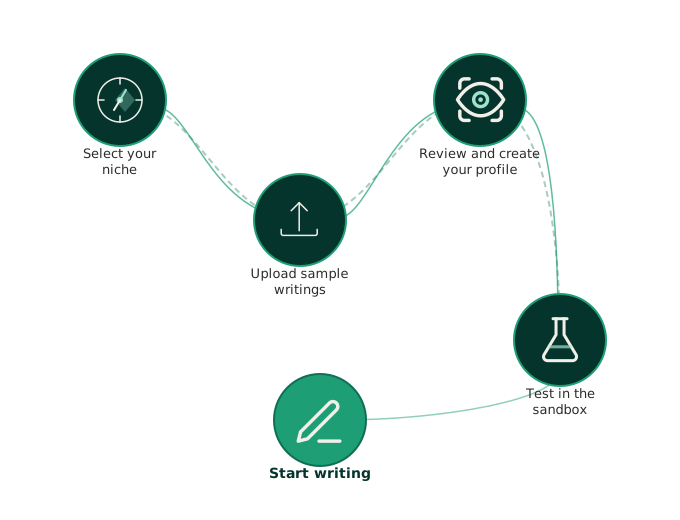
Your profile is the difference

Workshop path

Choose your niche and Riterly pre-loads a foundation that already understands your content type — the conventions, the structure, the expectations — before you've written a single word.

From there, the Voice Workshop builds your writing profile. Not from your answers to questions about your voice — from your actual writing. Upload samples of things you've already published, and Riterly analyzes what it finds.

Most people can't accurately describe their own voice. The Voice Workshop skips the self-report and goes straight to the evidence.

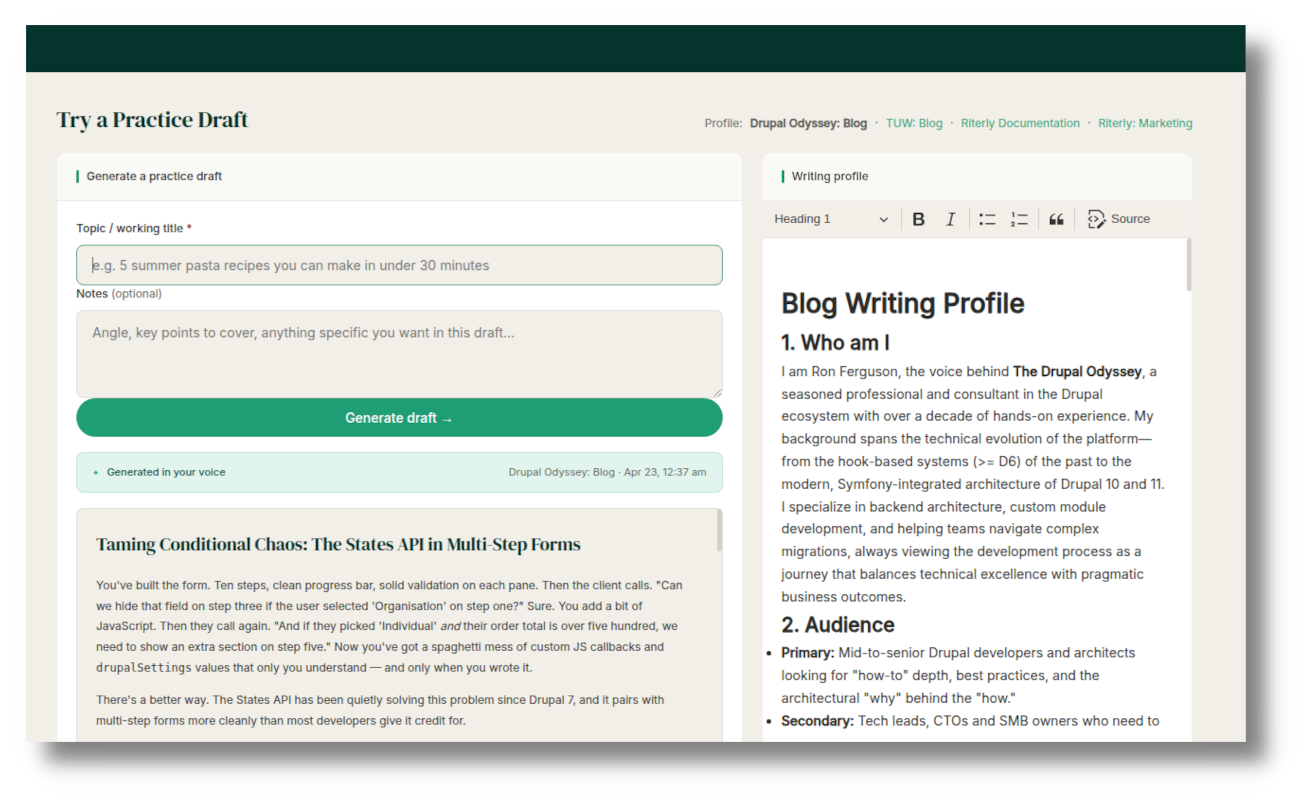
The sandbox: before you publish anything

Image
Riterly Sandbox

After you complete the Voice Workshop, Riterly puts you in a sandbox before you create any real content. One job: making sure the profile actually sounds like you.

Sandbox runs don't appear on your content board, and can't be published. The only job is tuning.

Generate something, read it back, and ask: does this sound like me? Adjust the profile until the answer is yes. Then you're ready.

There are two distinct jobs in Riterly, and they stay separate on purpose. The sandbox is for profile confidence. The pipeline is for real content.

One account, more than one voice

Some people write in more than one register:

  • A developer who also publishes a personal newsletter
  • A marketing team that handles a brand blog and an executive's LinkedIn
  • A consultant who writes both technical documentation and opinion pieces

Riterly handles this with multiple profiles. Each one is independent — its own niche, its own Voice Workshop output, its own language patterns and structural preferences. When you're working in the pipeline, you're working from one profile at a time.

The thing worth saying plainly: these profiles aren't prompts. They're not something you reconstruct each session. They're permanent, structured, and get sharper the more you use them. Not a note you typed this morning and forgot by tomorrow.

If voice matters to what you're building — not just having a voice, but maintaining it across everything you publish — that persistence is the whole game.

Set up your profile and see what comes back.

The best way to understand what the profile actually does is to see it working on your own writing. Request early access, set up your writing profile in the Voice Workshop, run a few sandbox drafts until it sounds right, then generate your first real piece.

Request early access